
Population growth puts strain on Pakistan’s water resources: ADB
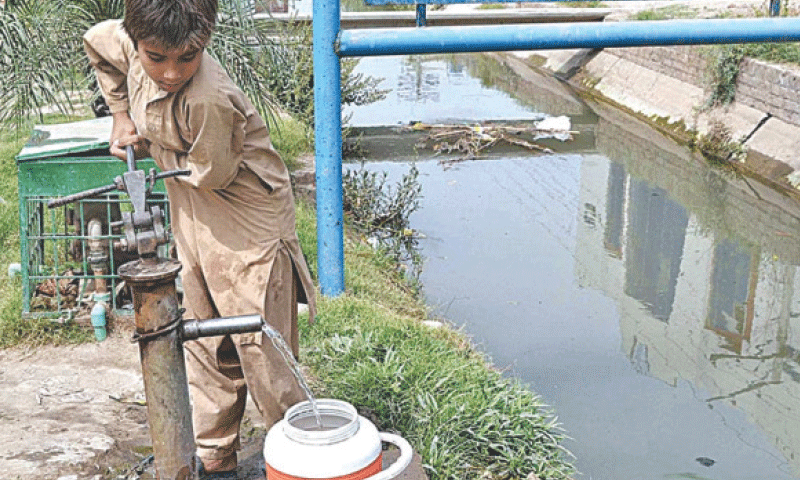
ISLAMABAD: With more than 80 per cent of its population lacking access to clean drinking water, Pakistan faces water insecurity, both in terms of quality and quantity, despite minor improvement over the past 12 years amid implementation gaps.
“Pakistan faces growing pressure on its water resources due to rapid population growth, climate change, and poor water management,” said the Asian Development Bank in the fifth edition since 2007 of its flagship Asian Water Development Outlook (AWDO).
The report, considered the Asian region’s most comprehensive assessment of water security, says that “more than 80pc of the population (in Pakistan) lacks access to safe drinking water, contributing to widespread waterborne diseases. Groundwater overuse in agriculture has led to depletion and arsenic contamination”.
In addition, climate-related hazards, such as erratic monsoons, glacial melt, and floods, add further strain, with the 2022 floods displacing millions. At the same time, upstream water control and infrastructure challenges continue to threaten the Indus River system, Pakistan’s lifeline, it said, recalling that per capita water availability had already dropped from 3,500 cubic metres (m³) in 1972 to just 1,100 m³ in 2020.
As if this were not enough, Pakistan’s rural household water security remains under pressure due to ineffective service models, limited surveillance, and persistent contamination, though improvements in hygiene and health outcomes have been observed.
“Economic water security is constrained by falling per capita water availability, insufficient storage, and heavy reliance on poorly monitored groundwater resources for industrial activity”.
Modest gains
On the other hand, urban water security has shown only modest gains, with rising demand, untreated wastewater, and urban flooding straining infrastructure and service delivery. Environmental water security has declined slightly, as rapid population growth, industrial activity, and untreated wastewater continue to degrade aquatic ecosystems.
Water-related disaster security fell during the early part of the period and has remained stagnant, with the country experiencing major flood and drought events, including glacial lake outburst floods (GLOF).
Overall, Pakistan’s national water security score improved moderately from 2013 to 2025 by 6.4 points.
At the same time, water governance performance, measured through SDG 6.5.1, rose from 50pc in 2017 to 63pc in 2023. This progress reflects a sound legal and policy foundation, aligned with Integrated Water Resource Management (IWRM) principles, but implementation remains weak.
The report observed that institutional fragmentation, limited coordination, low technical capacity, and underinvestment continue to restrict progress, especially in light of growing population pressures, climate risks, and systemic inefficiencies in water management.
Gap between plan & execution
The report appreciated Pakistan’s National Water Policy, announced in 2018, but noted that the gap between planning and implementation resulted in a limited impact. Efforts to improve equity, participation, and resilience are underway but require stronger integration across sectors and levels of government.
“Without more coordinated and well-financed governance, gains in water security will remain uneven and difficult to sustain”, it warned.
The ADB advised strengthening institutional coordination under the National Water Council, a body for policy implantation announced in 2018 but still to be born, introducing volumetric pricing to promote efficiency and investment, embedding gender, equity, and social inclusion in decision-making, establishing an independent water quality authority, and expanding environmental regulation and ecosystem protection.
The analysis is based on five critical indicators called Key Dimensions (KDs). It said rural household water security (KD1) improved from 4.1 in 2013 to 7.6 this year, but access to basic services remains low. The gains were mainly in hygiene and health outcomes, supported by targeted water, sanitation and hygiene (WASH) programmes and possibly reinforced by hand washing campaigns during Covid-19.
However, rural water supply models remain ineffective, and surveillance is limited. Microbiological and geogenic contamination are widespread, and policies have not kept pace with growing rural demand.
Economic water security (KD2) remained almost unchanged, increasing slightly from 9.1 in 2013 to 10 this year. Despite some progress in broader economic resilience, gains were offset by water scarcity and inefficient systems.
Agriculture, industry, and energy sectors all face water-related constraints.
Urban water security (KD3) showed stronger gains, rising from 7.5 in 2013 to 9.2 this year. Access to services improved slowly, and urban utilities remain under pressure from a 10pc annual increase in demand. Underlying issues, like weak infrastructure, low tariffs, and poor cost recovery need to be addressed continuously.
Environmental water security (KD4) declined slightly, dropping from 9.6 in 2013 to 9.2 in 2025. Population growth, urban expansion, and untreated wastewater are placing fresh water ecosystems at risk.
Despite stronger legal frameworks, enforcement remains weak. Aquatic ecosystems, including the Indus River, wetlands, and marine zones, face increasing degradation due to pollution and reduced environmental flows.
Disaster security
Water-related disaster security (KD5) has improved slightly between 2013 and 2025, rising from 10.8 to 11.5, and crossing into a higher water security step. This modest gain comes despite severe events such as the 2022 floods, which affected over 24 million people and exposed critical gaps in resilience.
Early-warning systems have strengthened, but investment in adaptive infrastructure and local risk reduction remains insufficient. Prolonged droughts continue to threaten food security, especially for smallholder farmers.
The report said that despite a 152pc increase in WASH funding between 2019 and 2023, Pakistan still faced a significant gap, falling short of the estimated $12.3 billion needed to meet SDG targets 6.1 and 6.2. Without stronger institutional frameworks and community participation, rural gains will remain uneven and fragile.